
How to Master Health News in 26 Days: Your Ultimate Guide to Health Literacy
In an era where a single viral tweet can spark a global health trend and headlines often scream contradictory advice, being a passive consumer of health news is no longer an option. One day, caffeine is a miracle antioxidant; the next, it’s a cardiovascular risk. To navigate this “infodemic,” you need more than just curiosity; you need a system. Mastering health news means developing the critical thinking skills to distinguish between rigorous science and sensationalist “clickbait.”
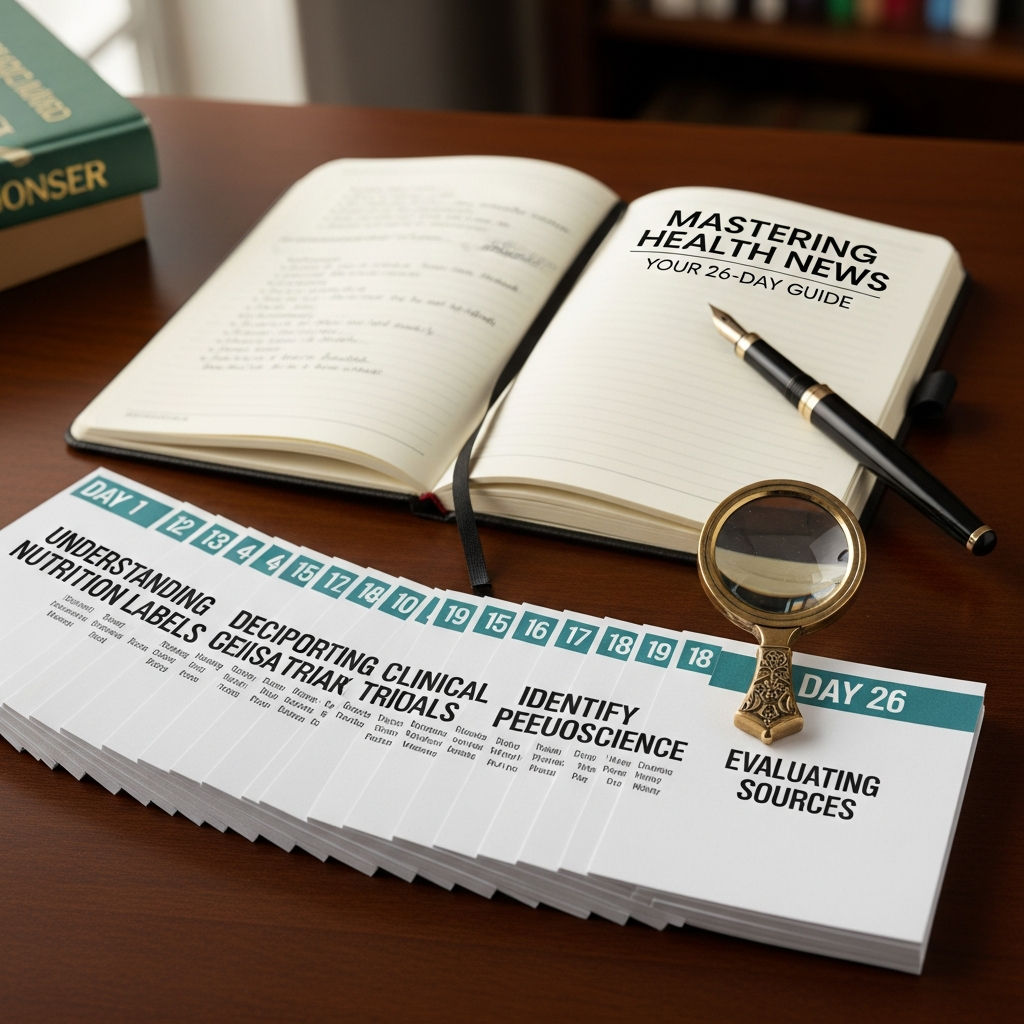
This 26-day roadmap is designed to transform you from a confused reader into a savvy health news analyst. By following this structured approach, you will learn to dissect medical studies, understand the nuances of clinical trials, and curate a news feed that prioritizes evidence over hype.
Week 1: Building Your Foundational Toolkit
The first seven days are dedicated to understanding the landscape of medical reporting and learning where the most reliable information lives.
Day 1-2: Identifying Tier-1 Sources
Not all outlets are created equal. Start by bookmarking “Tier-1” sources. These include peer-reviewed journals like The Lancet, The New England Journal of Medicine (NEJM), and JAMA. While these are technical, their press releases and abstracts are the gold standard. Contrast these with general news outlets to see how information is “translated”—and often diluted—for the public.
Day 3-4: Understanding the Hierarchy of Evidence
Not every study carries the same weight. On these days, learn the “Evidence Pyramid.” At the bottom are animal studies and expert opinions; in the middle are case-control studies; and at the top are Randomized Controlled Trials (RCTs) and Meta-Analyses. If a headline claims a “cancer breakthrough” but the study was performed on mice (in vivo), you’ll know to view it with cautious optimism rather than immediate certainty.
Day 5-7: Decoding Medical Jargon
Spend the weekend learning 10 key terms: double-blind, placebo-controlled, longitudinal, statistically significant, p-value, cohort, systemic review, observational study, absolute risk, and relative risk. Understanding these terms is the “secret code” to unlocking what a study actually concludes versus what the headline implies.
Week 2: Developing a Critical Eye
Now that you know where to look, Week 2 is about how to look. This is the stage where you learn to spot the red flags of health misinformation.
Day 8-10: Correlation vs. Causation
This is the most common pitfall in health reporting. Just because people who eat blueberries live longer doesn’t mean blueberries *cause* longevity; it might mean people who can afford blueberries also have better healthcare. Practice looking for the “confounding variables” in every health story you read.
Day 11-12: The Power of Sample Size
A study involving 12 people is a pilot study, not a definitive conclusion. During these two days, look at the “n” number in news reports. If the sample size is small, the results are preliminary. Mastering health news requires recognizing that small-scale studies are meant to inspire further research, not change your lifestyle overnight.
Day 13-14: Identifying Conflict of Interest
Follow the money. On these days, practice scrolling to the bottom of research papers to the “Disclosures” or “Funding” section. If a study praising the benefits of sugar is funded by the soft drink industry, you have identified a significant bias. A master of health news always checks who paid for the seat at the table.
Week 3: Deep Dives and Data Analysis
By Week 3, you are ready to move past the headlines and into the data itself. This is where you separate the “signal” from the “noise.”

Day 15-17: Relative vs. Absolute Risk
News outlets love “Relative Risk” because it sounds dramatic. A headline might say, “New Drug Increases Heart Attack Risk by 50%!” That sounds terrifying. However, if the absolute risk goes from 1 in 1,000 to 1.5 in 1,000, the “50% increase” is statistically true but clinically minor for most people. Learn to hunt for the absolute numbers.
Day 18-20: Using Fact-Checking Tools
You don’t have to do it all alone. Use these days to familiarize yourself with professional health fact-checking sites. Websites like HealthFeedback.org and Retraction Watch are invaluable. They employ scientists to debunk viral health myths and track which studies have been pulled due to errors or fraud.
Day 21: Navigating Pre-prints
In the wake of the COVID-19 pandemic, “pre-print” servers like bioRxiv and medRxiv became mainstream. These are studies that have not yet been peer-reviewed. Learn to treat pre-prints as “works in progress” rather than established facts.
Week 4: Synthesis and Long-Term Mastery
In the final stretch, you will learn how to maintain your skills and apply your knowledge to make better personal health decisions.
Day 22-23: Spotting “Science-y” Buzzwords
Marketers use “science-y” words to bypass your critical thinking. Phrases like “clinically proven,” “toxin flush,” “superfood,” and “all-natural” are often devoid of medical meaning. Spend these days analyzing health advertisements and product labels. If a product claims to “boost the immune system,” ask yourself: which part of the immune system? T-cells? B-cells? If they can’t specify, it’s likely marketing, not medicine.
Day 24-25: Curating Your Digital Environment
Your “health news health” depends on your algorithm. Unfollow accounts that promote “miracle cures” or use fear-based tactics. Follow experts who admit when they are wrong and who provide nuances. Use tools like Google Scholar Alerts for specific topics you care about (e.g., “Type 2 Diabetes research”) to get direct access to new data.
Day 26: The Synthesis Challenge
On your final day, pick a trending health topic. Find the original study, check the sample size, look for the funding source, calculate the absolute risk, and compare the study’s conclusion to a major news outlet’s headline. If you can spot the discrepancies, you have officially mastered health news.
Conclusion: The Lifelong Journey of Health Literacy
Mastering health news in 26 days isn’t about knowing every medical fact; it’s about mastering a process of inquiry. Science is a self-correcting endeavor, and what we know today may be refined tomorrow. By applying the critical thinking skills, source verification, and data analysis techniques you’ve learned, you are no longer a victim of the “headline of the day.”
Instead, you are an empowered advocate for your own well-being. True health literacy is the ability to stay calm in the face of sensationalism and to make informed decisions based on the weight of evidence. Keep questioning, keep verifying, and remember: if a health claim sounds too good to be true, it almost certainly is.
- Key Takeaway: Always prioritize peer-reviewed meta-analyses over single-study headlines.
- Action Item: Start your Day 1 today by identifying three Tier-1 medical journals to follow.
- Final Thought: Mastery is a muscle—exercise your critical thinking daily.